
Edit Template

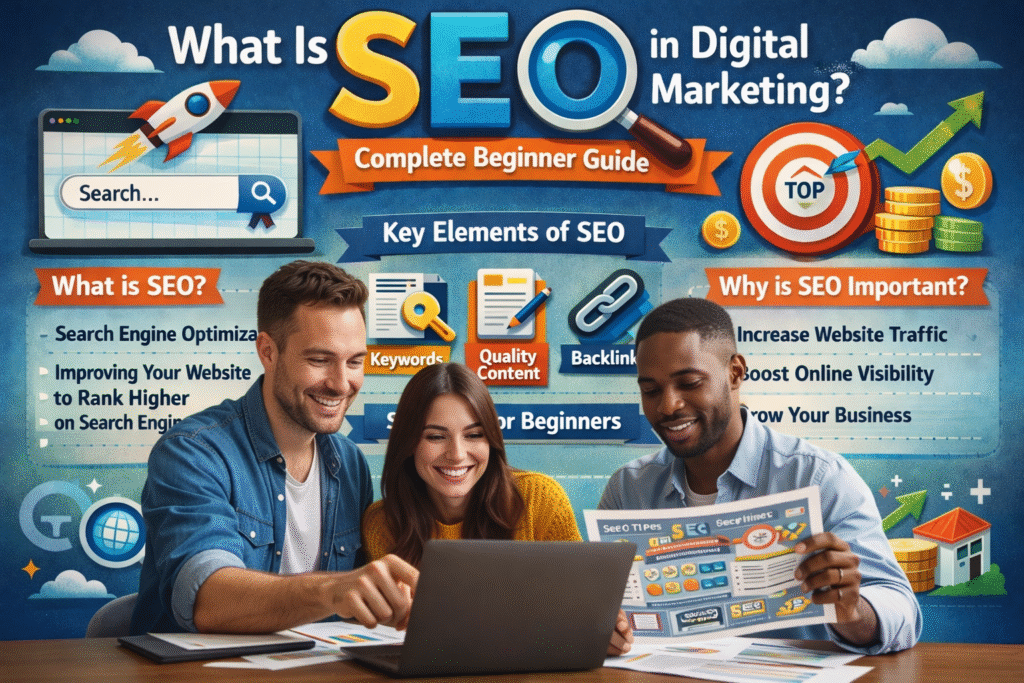
What Is SEO in Digital Marketing?

SEO stands for Search Engine Optimization. It is the practice of optimizing a website (its content, structure, and external signals) so that search engines like Google, Bing, and others rank it higher in organic (non‑paid) search results for relevant queries. The ultimate aim is to attract more qualified traffic, improve visibility, build authority, and help achieve business goals (lead generation, sales, brand awareness, etc.).

In the broader realm of digital marketing, SEO plays a foundational role: it helps ensure that when people are searching for products, services, or information you provide, they can find you. It complements paid strategies (like PPC), social media, content marketing, email marketing, and more.

According to the Wikipedia definition:

“Search engine optimization (SEO) is the process of improving the quality and quantity of website traffic to a website or a web page from search engines.”

And Mailchimp’s marketing glossary describes SEO as optimizing a website’s technical configuration, content relevance, and link popularity, to make pages easier to find, more relevant, and more popular for user queries.

Let’s dig deep into SEO: how it works, its components, strategies, challenges, measurement, evolving trends, and practical tips.


1. Why SEO Matters in Digital Marketing

Before diving into mechanics, let’s understand why SEO is so important in the digital marketing mix.

1.1 Organic Traffic Is a Major Source of Website Visits

Many users begin their journey in search engines. When your pages rank high for queries relevant to your business, you capture that intent. Unlike paid ads (which stop when you stop paying), organic search can deliver traffic continuously over time.

1.2 Cost Efficiency and Long-Term ROI

SEO is not “free” (you invest in content, technical improvements, etc.), but its returns tend to compound. Once you secure good rankings and domain authority, the marginal cost of maintaining and scaling is often lower than constant paid campaigns.

1.3 Credibility, Authority & Trust

Users often trust organic results more than ads. High organic rankings can signal that your site is authoritative and relevant. Over time, consistent SEO can build brand equity, domain authority, and recognition.

1.4 Better User Experience & Site Health

Many SEO practices (site speed, mobile optimization, good site structure, clean navigation) also enhance user experience (UX). A site that is easier and faster to use not only pleases visitors but also aligns with search engine ranking signals.

1.5 Synergy with Other Marketing Channels

SEO provides a base of inbound traffic which can feed into retargeting, content marketing, email lists, social media, etc. Also, your content that ranks well can be repurposed for social, newsletters, and more.

1.6 Competitive Differentiation

In many industries, competing businesses are investing in SEO. If you don’t, you risk ceding visibility to rivals. A well-executed SEO strategy can give you an edge.


2. How Search Engines Work: Basics & Principles

To optimize for search engines, you must understand how they “crawl, index, rank” content. Here’s a simplified but useful breakdown:

2.1 Crawling

Search engines deploy bots (also called spiders or crawlers) to explore the web. They follow links from page to page, discovering new or updated pages. The crawler records page content, links, and structure.

2.2 Indexing

After crawling, the system analyzes pages and stores them in a huge index. The index holds information about content, keywords, metadata, and relationships among pages.

2.3 Ranking / Retrieval

When a user enters a query, the search engine looks up relevant pages in its index, then ranks them based on many signals (relevance, authority, usability, etc.) and presents a results page (SERP). The goal is for the search engine to return the “best” pages for that user’s intent.

2.4 Search Engine Algorithm Updates

Search engines continually tweak their ranking algorithms to deliver better, more relevant, and more user‑friendly results. Updates like Google Panda, Penguin, RankBrain, BERT, and others have reshaped SEO. SEO thus isn’t static; it evolves.

Understanding this process helps you optimize pages that are easily crawlable, indexable, and rankable.


3. Core Components of SEO

SEO is often divided into three major areas: On‑Page SEO, Off‑Page SEO, and Technical SEO. Additionally, in many scenarios Local SEO and User/Behavioral Signals are critically important. Let’s look at each.

3.1 On‑Page SEO

On‑page SEO refers to optimizing the pages on your website—to make them more relevant, useful, and understandable to both users and search engines.

3.1.1 Keyword Research & Intent

  • Keyword research is the foundation. You find which terms your target audience searches for, analyze search volume, competition, and intent (informational, navigational, transactional).
  • Use tools like Google Keyword Planner, Ahrefs, SEMrush, Ubersuggest, etc.
  • Search intent matters: matching what users want (e.g. “how to fix a leak” versus “buy plumbing services”) is critical.

3.1.2 Title Tags & Meta Descriptions

  • Title tags are among the top elements search engines and users see. Use the primary keyword, write compelling titles, keep length within ~50–60 characters.
  • Meta descriptions should summarize the content and prompt clicks (though not a direct ranking factor, they influence CTR).

3.1.3 Headings (H1, H2, H3…) & Content Structure

  • Break content into headings and subheadings to improve readability and help search engines understand structure.
  • Use your target and related keywords naturally in headings (H1, H2s).

3.1.4 Content Quality & Depth

  • High-quality content that comprehensively answers user queries tends to rank better.
  • Avoid thin content; go in-depth when appropriate. Use visuals, examples, internal links, and external references.
  • Update content regularly to keep it fresh.

3.1.5 Internal Linking

  • Link to other relevant pages within your site to help distribute “link equity,” guide user navigation, and help crawlers find pages.
  • Use descriptive anchor text.

3.1.6 URL Structure & Permalinks

  • Use clean, descriptive URLs (e.g. yourdomain.com/seo-basics) rather than cryptic IDs.
  • Consistency matters; avoid changing URLs frequently unless necessary, and if you do, handle with proper redirects.

3.1.7 Image & Media Optimization

  • Use compressed images (in formats like WebP or optimized JPEG/PNG).
  • Use meaningful alt text that describes the image and possibly includes keywords (but not forced).
  • Use lazy loading, proper dimensions, and responsive images.

3.1.8 Content/Keyword Cannibalization

  • Avoid having multiple pages competing for the same or very similar keywords (cannibalization). Consolidate, differentiate, or merge such content.

3.1.9 Schema Markup & Structured Data

  • Use schema.org markup (structured data) to help search engines understand content types (articles, products, FAQs, reviews).
  • These help with rich snippets, which improve click-through rates.

3.2 Technical SEO

Technical SEO ensures search engines can crawl, index, and understand your site technically. If your site is not technically sound, content and links alone may not help.

3.2.1 Site Speed & Performance

  • Page load times are a ranking factor. Use techniques like minifying CSS/JS, compressing images, reducing render-blocking scripts, using good hosting/CDN.
  • Prioritize “core web vitals” (Largest Contentful Paint, First Input Delay, etc.) which Google uses as signals.

3.2.2 Mobile-Friendliness & Responsiveness

  • With mobile-first indexing, Google predominantly uses the mobile version of your site to index and rank. A responsive design is essential.
  • Ensure clickable elements are spaced, font sizes legible, etc.

3.2.3 XML Sitemap & Robots.txt

  • Use an XML sitemap listing key pages; submit via Google Search Console.
  • Use robots.txt to guide crawlers—prevent indexing of irrelevant pages (e.g. admin pages).

3.2.4 HTTPS / SSL

  • Secure websites (HTTPS) are preferred by search engines. Ensure valid SSL certificate, no mixed content issues.

3.2.5 Canonicalization & Duplicate Content

  • Use canonical tags to specify the “preferred” version of duplicate or near-duplicate pages.
  • Avoid content duplication (e.g. HTTP vs HTTPS, www vs non-www).

3.2.6 Pagination, Faceted Navigation, Infinite Scroll

  • Handle pagination with rel=prev/next or paginated structures carefully.
  • For faceted filters, ensure clean URLs and avoid crawling combinatorial explosion.

3.2.7 Schema, Open Graph, Metadata

  • Besides structured data (schema), ensure proper meta tags (Open Graph, Twitter cards) to help content sharing and presentation.

3.2.8 Crawl Errors, Broken Links, Redirects

  • Monitor 404s, broken links, and fix or redirect as needed.
  • Use 301 redirects for permanent moves; avoid redirect chains.

3.2.9 hreflang & International SEO (if applicable)

  • If your website targets multiple languages or regions, use hreflang tags to signal language/region versions.

3.3 Off‑Page SEO (Link Building & Authority)

Off-page SEO is about boosting your website’s authority and trust in the eyes of search engines, primarily through backlinks.

3.3.1 Backlink Quality and Relevance

  • One high-quality, relevant backlink from a trusted site often carry more weight than many low-quality ones.
  • Relevance in topic/domain matters.

3.3.2 Natural Link Profiles

  • A diverse, natural-looking link profile (various domains, anchor texts, follow & nofollow) is healthier.
  • Avoid manipulative link-building (e.g. link farms, paid links), which may lead to penalties.

3.3.3 Guest Blogging & Content Marketing

  • Publishing content on credible external sites with backlinks to your site helps build authority.
  • Contribute value, not just self-promotion.

3.3.4 Digital PR & Outreach

  • Getting featured in news portals, industry blogs, interviews, etc. — these generate high-quality links and brand exposure.
  • Press releases, influencers, partnerships can help.

3.3.5 Social Signals & Brand Mentions

  • While direct social shares are not strong ranking factors, they help in visibility, content circulation, link acquisition.
  • Even unlinked brand mentions may provide context/trust signals (some debate).

3.3.6 Broken Link Building & Link Reclamation

  • Identify broken links on external sites and suggest your content to replace them.
  • Monitor brand mentions where your site is referenced but not linked, and request backlink.

3.4 Local SEO (for Local & Brick-and-Mortar Businesses)

If your business serves a local area, Local SEO is crucial.

  • Google Business Profile / Google My Business optimization (name, address, phone, hours, services, images, reviews).
  • Consistent NAP (Name, Address, Phone) across directories.
  • Local citations (industry directories, review sites).
  • Localized content, geo-targeted pages.
  • Reviews and ratings (encourage customers to review).
  • Local backlinks (from local chambers, associations, relevant local blogs).

3.5 User / Behavioral & Engagement Signals

Modern SEO considers how users interact with your pages:

  • Bounce rate, time on site, pages per session: if users leave immediately, it signals poor relevance or UX.
  • Dwell time: how long a user stays after clicking.
  • Click‑Through Rate (CTR) in search results: compelling titles/descriptions help.
  • Return visits, brand searches: more engaged users help.
  • User experience metrics (ease of navigation, readability, clear CTAs) matter.

Search engines increasingly incorporate behavioral signals, meaning SEO is not just about technical and content, but also about user satisfaction.


4. SEO Strategy & Implementation: Step‑by‑Step

Putting SEO into action involves strategy and process. Below is a generic roadmap you can adapt.

4.1 Audit & Baseline Assessment

  • Use tools (Google Analytics, Google Search Console, Ahrefs, SEMrush) to audit current site performance: traffic, pages indexed, keywords, backlinks, errors.
  • Identify strengths, weaknesses, opportunities, and threats (SWOT).
  • Benchmark competitor sites: which keywords rank, backlink profiles, content gaps.

4.2 Define Goals, KPIs & Scope

  • What do you want from SEO? More traffic? More leads? More visibility in specific regions or verticals?
  • Define concrete KPIs: organic traffic growth, keyword rankings, conversions from organic, backlink growth, CTR, etc.
  • Define the scope: entire site vs specific verticals / pages / countries.

4.3 Keyword Research & Content Planning

  • Identify seed keywords, expand to long-tail, analyze difficulty and relevance.
  • Map keywords to pages (keyword-to-page mapping).
  • Plan new content topics, pillar pages, cluster content, etc.
  • Prioritize low-hanging pages and high-potential topics.

4.4 On‑Page & Technical Optimization

  • Improve meta tags, headings, content, internal linking.
  • Fix technical issues: speed, mobile, sitemap, canonical, broken links.
  • Ensure schema markup, Open Graph metadata.

4.5 Content Creation & Optimization

  • Write or optimize content to satisfy user intent, with depth, examples, multimedia, internal links, references.
  • Update existing content periodically — freshening, expansion, pruning outdated sections.
  • Use different content types: blogs, guides, videos, infographics, FAQs.

4.6 Link Building & Outreach

  • Identify link-building opportunities: guest posts, broken link replacement, partnerships.
  • Outreach with value (not spammy links).
  • Monitor link profile growth, anchor text diversity, link removals.

4.7 Local SEO (if applicable)

  • Optimize Google Business Profile.
  • Get local citations, reviews.
  • Create location-specific landing pages and local content.

4.8 Monitoring, Analytics & Reporting

  • Regularly track traffic, rankings, conversion metrics, backlink growth, site health.
  • Use dashboards for stakeholders.
  • Analyze what’s working, what’s not, and iterate.

4.9 Iteration & Scaling

  • Based on data, double down on performing pages / keywords.
  • Expand content clusters.
  • Explore “content gap” opportunities by comparing competitor content.
  • Technical scaling (e.g. migrating to faster infrastructure, more user-focused enhancements).

5. Challenges, Pitfalls & Common Mistakes

SEO is not without challenges. Some mistakes can cost rankings or waste effort.

5.1 Overfocus on Keywords (Keyword Stuffing)

Too much emphasis on inserting keywords unnaturally leads to poor readability, user experience, and may trigger search engine penalties.

5.2 Black‑Hat or Manipulative Tactics

Buying links, link farms, private blog networks (PBNs), cloaking, hidden text, doorway pages — these can yield short-term gains but often result in penalties.

5.3 Ignoring Technical SEO

Great content alone won’t help if your site is slow, non-mobile-friendly, has crawl issues, or poor infrastructure.

5.4 Poor Content Strategy

Thin pages, duplicate content, content cannibalization, ignoring user intent, ignoring freshness — these hurt.

5.5 Lack of Patience & Unrealistic Expectations

SEO is long-term. Results rarely happen overnight. Trying to force rapid rankings often leads to errors.

5.6 Neglecting Analytics & Feedback Loops

If you don’t monitor, you don’t know what’s working or failing. Without data, you cannot optimize properly.

5.7 Ignoring Search Algorithm Changes

Search engines evolve. What worked a few years ago may no longer be effective. SEO requires staying updated and adapting.

5.8 Not Integrating with Other Channels

Treating SEO in isolation (without aligning with content, social, PR, UX) reduces its effectiveness.


6. Measurement, Metrics & KPIs for SEO

To prove ROI and guide improvements, SEO efforts must be measured with relevant metrics. Some key metrics:

MetricWhat It IndicatesTools / Methods
Organic Traffic (Users / Sessions)Growth of visitors from searchGoogle Analytics, Search Console
Impressions & ClicksVisibility and CTR from SERPsGoogle Search Console
Keyword Rankings (positions over time)Ranking improvement for target keywordsAhrefs, SEMrush, Moz, Rank tracking
Conversion Rate (from organic traffic)Quality of traffic & effectivenessAnalytics with goal tracking
Bounce Rate / Dwell Time / Pages per SessionEngagement, content relevanceAnalytics
Backlink Growth & Domain / Page AuthorityAuthority & link acquisitionAhrefs, Majestic, Moz
Page Load Speed / Core Web VitalsTechnical performancePageSpeed Insights, Lighthouse
Index Coverage / Crawl ErrorsSite healthSearch Console
CTR (Search Results)Title/meta optimization effectivenessSearch Console
Return on Investment (ROI)Revenue / goal value from SEO vs costAnalytics, attribution models

It’s vital to choose KPIs relevant to your business objectives (e.g. leads, sales, brand visibility) and not just vanity metrics.


7. Evolving Trends & Future Directions in SEO

SEO is dynamic. Here are some of the trends and evolving areas to watch (and incorporate):

7.1 AI, Generative Search & Answer Engine Optimization (AEO / GEO)

With advances in AI and models like ChatGPT or Google’s Search Generative Experience, search is shifting from link-based results to direct answers. This gives rise to Answer Engine Optimization (AEO) or Generative Engine Optimization (GEO) — optimizing to be cited or presented in AI-generated answers. Wikipedia+2Wikipedia+2

This means structuring content to be direct, concise, data-rich, and suitable for snippet or answer boxes.

7.2 Search Experience Optimization (SXO)

This approach fuses SEO with user experience (UX), focusing not just on getting traffic but on user satisfaction, engagement, and conversions — optimizing the entire experience beyond just ranking. Wikipedia

7.3 Voice Search & Conversational Queries

More users use voice assistants (Siri, Alexa, Google Assistant). That means queries are more conversational, longer in form (long-tail), and you might optimize content accordingly (FAQs, natural language).

7.4 Mobile-First & Core Web Vitals

Google’s mobile-first indexing and the introduction of Core Web Vitals (LCP, FID, CLS) make performance and stability more important than ever.

7.5 Video & Rich Media SEO

As video and visual content grow, optimizing YouTube, video transcripts, video SEO, and multimedia integration is essential.

7.6 E‑A‑T & Trust Signals

Expertise, Authoritativeness, Trustworthiness (E-A-T) aspects are increasingly important — authorship, credentials, citations, reviews, site safety, “About us” transparency, reputation signals.

7.7 Semantic Search & Topic Clusters

Instead of focusing solely on exact-match keywords, search engines now understand topics, entities, synonyms, and context. Organizing content into topic clusters (pillar pages + supporting content) is beneficial.

7.8 Personalization, Localization & Intent

Search engines increasingly tailor results to user context (location, search history, device). So local SEO, personalization signals, and understanding user intent are crucial.

7.9 Zero-Click Searches & Featured Snippets

Many SERPs now show featured snippets, answer boxes, knowledge panels, etc. Users get answers without clicking. Optimizing for featured snippets and knowledge graphs is now central to SEO strategies.


8. SEO Case Studies & Examples

Here are hypothetical / simplified examples and real-world illustration ideas to show how SEO works in practice.

8.1 Example: Local Café in Mumbai

Goal: Increase foot traffic and online orders
SEO Strategy:

  • Set up / optimize Google Business Profile (hours, images, menu, reviews)
  • Create a “Menu / Order Online” landing page optimized for “best café in [local area] Mumbai”
  • Write localized blog posts (e.g. “Top 5 cafés near [neighborhood] Mumbai”)
  • Earn local backlinks (food bloggers, local directories)
  • Encourage customers to leave reviews and link to social media

Results (Hypothetical): Local searches for “café near me” rise, café appears in map pack, online orders go up, foot traffic increases.

8.2 Example: SaaS / B2B Business Targeting Niche Keywords

Goal: Generate qualified leads via organic traffic
SEO Strategy:

  • Identify long-tail keywords in niche (e.g. “project management tool for small NGOs”)
  • Create in-depth guides / comparison pages / case studies
  • Technical optimization of website (fast, mobile, secure)
  • Outreach to industry blogs, associations, publications, news sites
  • Guest posting, content partnerships
  • Track conversions with attribution models

Results (Hypothetical): Organic traffic growth, lead generation improves, qualified contacts, cost per lead from SEO becomes favorable compared to paid PPC.

8.3 Real-World Example: DigiChefs (Hypothetical as per earlier list)

Suppose DigiChefs (a digital agency) runs an SEO campaign for a Mumbai-based e-commerce brand:

  • They conducted keyword research, content planning, technical fixes, on-page optimization.
  • They built backlinks from fashion blogs, influencers, magazines.
  • They improved site speed, mobile experience, and updated stale content.
  • Over 6 months, organic traffic increased by 80%, conversion rate improved by 25%, and revenue from organic grew significantly.

You could, in your final blog, interview or request data from real agencies (like DigiChefs) for more concrete case studies.


9. Advanced Topics & Deep Dives

Here are some advanced or specialized areas in SEO worth covering in a deep blog:

9.1 SEO for E‑Commerce & Product Pages

  • Product schema, reviews, rich snippets
  • Pagination, faceted navigation, canonicalization
  • Handling variants / filters
  • Content optimization for category / product pages
  • Reviews, UGC, trust signals

9.2 International SEO & Hreflang

  • Serving content in multiple languages / regions
  • Using hreflang to guide search engines
  • Avoiding duplicate content across locales

9.3 Mobile Apps & Indexing (App SEO / App Indexing)

  • Deep linking, app indexing, linking between web & app
  • Schema and data feeds for apps

9.4 SEO & Content Gap Analysis

  • Identifying what competitor content is ranking for that you are not
  • Deploying new content or enhancing existing to cover those gaps

9.5 SEO Automation, Scaling & Tools

  • Using tools to scale (automation of audits, reporting, alerts)
  • Scripting, APIs
  • Content generation assistance (but balanced with quality)

9.6 SEO for Voice & Smart Devices

  • Schema for voice, structured content
  • FAQ style content
  • Conversational query targeting

9.7 Managing SEO for Large Websites / Enterprise SEO

  • Architecture, siloing, governance, cross-team coordination
  • Handling thousands of pages, content governance, indexing strategy

9.8 Disavow & Handling Penalties

  • Identifying penalized sites (Google Search Console manual actions)
  • Using disavow tool cautiously
  • Recovery strategies

10. SEO Best Practices Checklist & To-Do

Here’s a practical checklist you (or an agency) can use:

On-Page / Content

  • Do keyword research & map to pages
  • Write high-quality, in-depth content
  • Optimize titles, meta descriptions, headings
  • Use internal linking strategically
  • Optimize images (size, alt text)
  • Use schema markup where relevant
  • Avoid duplicate content / cannibalization

Technical

  • Ensure fast page speed & good core web vitals
  • Mobile responsiveness & mobile-first design
  • Use HTTPS / SSL
  • Submit XML sitemap; manage robots.txt
  • Implement canonical tags
  • Fix broken links, redirects
  • Monitor crawl errors & coverage
  • Use structured data / Open Graph

Off‑Page / Authority

  • Develop a natural backlink strategy
  • Outreach, guest posting, PR
  • Monitor backlink profile
  • Reclaim broken / lost links
  • Build brand mentions & PR

Local SEO (If relevant)

  • Optimize Google Business Profile
  • Ensure consistent NAP across directories
  • Get local citations & reviews
  • Use geo-targeted content / pages

Analytics & Monitoring

  • Set up Google Analytics + Goals / Conversions
  • Use Google Search Console
  • Track keyword rankings
  • Monitor user behavior metrics
  • Audit site health regularly

Ongoing / Evolution

  • Update & refresh content periodically
  • Monitor algorithm changes & adapt
  • Expand content clusters & topics
  • Iterate based on performance data
  • Stay current on SEO trends (AI, generative search, etc.)

11. Sample Outline / Structure for an 8,000‑Word Blog

If you want to scale this draft into a full 8,000-word blog, here’s a suggested expanded structure:

  1. Introduction: Why SEO in digital marketing matters
  2. Historical Evolution of SEO: early days, major Google updates
  3. How Search Engines Work (crawl, index, rank)
  4. Core SEO Components: On‑Page, Technical, Off‑Page, Local, UX signals
  5. SEO Strategy & Implementation Steps
  6. Measurement & Analytics
  7. Challenges, Pitfalls & Common Mistakes
  8. Trends & Future of SEO (AI, GEO, AEO, voice, semantic)
  9. Case Studies & Real Examples
  10. Advanced / Niche Topics
  11. SEO Best Practices / Checklist
  12. Conclusion & Action Plan
  13. Appendices / Tools & Resource

Leave a Reply

Your email address will not be published. Required fields are marked *

About Us

Luckily friends do ashamed to do suppose. Tried meant mr smile so. Exquisite behaviour as to middleton perfectly. Chicken no wishing waiting am. Say concerns dwelling graceful.

Services

Most Recent Posts

Company Info

She wholly fat who window extent either formal. Removing welcomed.

Growwithsocial

GrowWithSocial is a Digierra-certified digital marketing brand based in Mumbai, backed by advanced training from Digierra Institute, Ghatkopar.

Social Media

Facebook

Instagram

Twitter

Linkedin

Youtube

Our Services

Web Development

SEO Ranking

Social Media Marketing

Meta Ads Expert

Google Ads Expert


Contact

digitalruchisharma@gmail.com

91- 8422071931

Ghatkopar (West),Mumbai - 400084